



A refinery may be reviewing proposals for additional sensors, a cloud platform, and a digital twin while engineers still spend hours reconciling information from existing systems. Each investment could have a purpose, but choosing where to begin requires a closer look at what is preventing teams from doing their work effectively.
Oil and gas industry technology trends can inform those choices, although the right sequence will differ between sites. A refinery that lacks reliable equipment measurements may need instrumentation first. Another may already collect the necessary data but struggle to connect it with planning and maintenance records.
The investment decision therefore depends on the operating problem, the capabilities already available, and the work required to make a new application usable. Our guide to downstream digital transformation explains the wider organizational context; here, the focus is on selecting and sequencing the technologies.
Start with the Operating Problem
A requirement such as “improve equipment visibility” leaves too much open to interpretation. Suppliers could respond with anything from a dashboard to a new sensor network, without knowing which assets matter or what the maintenance team needs to decide.
A more specific requirement would be to give maintenance engineers a consistent view of selected pump-condition measurements before their daily review. This identifies the users, assets, timing, and purpose, making it easier to assess whether the existing systems can provide what is needed.
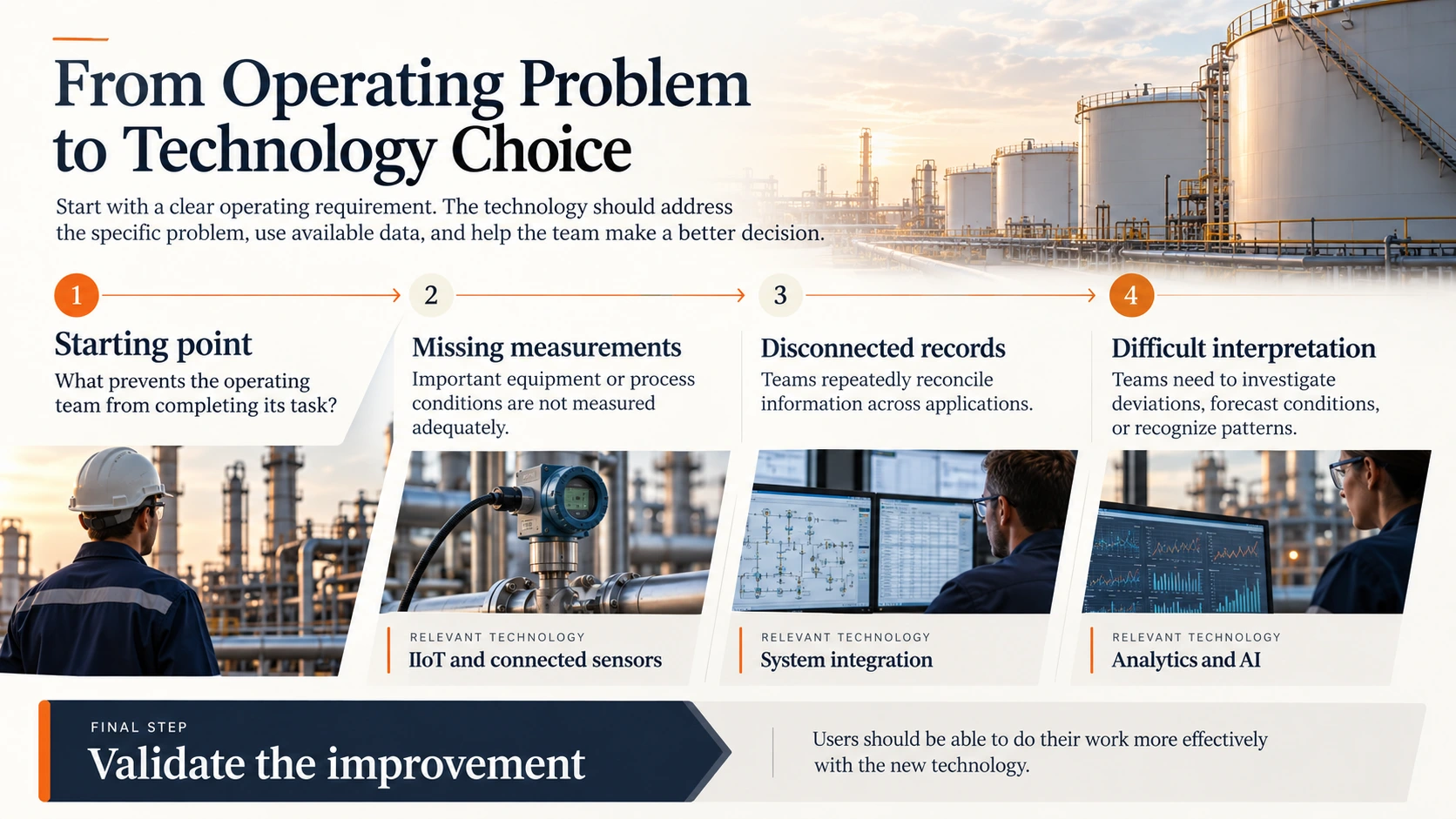
If measurements are missing, additional instrumentation may be justified. If the readings already exist but engineers collect them manually, integration may be the more relevant investment. Where the difficulty lies in interpreting those readings, the team may need an analytical application.
Evaluating digital technology in the oil and gas industry this way gives each proposal a practical test: what will users be able to do better once it is implemented?
Match the Technology to the Decision
Downstream technology priorities depend on what prevents a team from completing an operating task. Missing measurements may justify IIoT, while disconnected records may make integration the first priority. Cloud and edge choices depend on processing, connectivity, and access requirements; AI and digital twins require suitable data and a decision their outputs can improve. These capabilities can develop in parallel where their prerequisites are already in place.
| Technology or Capability | Operating problem it can address | Dependencies to check | Evidence to seek before expanding |
| Industrial Internet of Things (IIoT) & connected sensors | Important equipment or process conditions are not measured adequately | Instrument suitability, installation requirements, calibration, connectivity, and maintenance ownership | Reliable measurements that inform a defined operating or maintenance decision |
| System integration | Teams repeatedly reconcile information across applications | Available interfaces, asset identifiers, timestamps, units, and access permissions | Less manual preparation and fewer unresolved data mismatches |
| Edge computing | Selected processing must remain close to equipment or continue during connectivity interruptions | Local infrastructure, update procedures, security, and recovery arrangements | Required response time and dependable operation under expected network conditions |
| Cloud platforms | Analysis requires shared access, scalable computing, or comparison across sites | Data-transfer design, access controls, connectivity, residency requirements, and cost management | Usable shared information with acceptable performance and ongoing cost |
| Analytics & AI | Teams need to investigate deviations, forecast conditions, or recognize patterns | Suitable data, process knowledge, validation, and response ownership | Better analysis or decisions compared with the existing method |
| Digital twins | Teams need to evaluate how an asset or process may behave under different conditions | A defined modeling purpose, suitable data, model calibration, and update ownership | Credible scenario results that inform a specific decision |
| Robotics & remote inspection | Access makes inspection difficult or exposes personnel to avoidable hazards | Site permissions, equipment suitability, inspection requirements, and competent review | Inspection evidence of sufficient quality for its intended use |
Add IIoT Where Measurements Are Missing
IIoT can extend visibility to assets and conditions that existing systems do not adequately capture. It should begin with a measurement requirement.
For example, a team investigating recurring equipment deterioration may need condition information that is absent from the existing historian. Before adding sensors, establish which measurements would change the investigation and how frequently they need to be collected.
The installation also needs an operating owner. Batteries, calibration, communications, and device replacement remain practical responsibilities after commissioning.
A new measurement stream is useful when it reaches the right person with enough context to interpret it. Asset identity, measurement units, timestamps, and operating state should accompany the readings.
Monitoring and control also require different design decisions. Adding a connected sensor does not automatically make its output suitable for changing a process setting or performing a protective function.
Connect Existing Systems Before Duplicating Their Work
Some sites already hold the information they need, but retrieving it requires repeated exports and manual reconciliation.
In this situation, another application may reproduce the same information without resolving the underlying problem. Integration should establish how existing historian, laboratory, maintenance, planning, and production records relate to one another.
The work involves more than transferring values. Teams need consistent references and a clear understanding of what each record represents. A successful connection must also make missing, delayed, or revised information visible.
Define the practical test early: can the intended user complete the task with less preparation and a dependable view of the relevant evidence?
Our article on oil and gas data analytics examines these operational data foundations in greater detail.
Decide What Belongs at the Edge and in the Cloud
Cloud and edge computing answer different deployment questions.
Edge computing places selected processing near the equipment or site. It may be appropriate when a workload needs a local response, when transmitting all raw data is impractical, or when some functions must continue through a network interruption.
Cloud platforms can provide shared storage and computing for broader analysis, collaboration, and comparisons across locations. They can also accommodate workloads whose computing requirements vary over time.
A combined design may be appropriate. Selected data can be processed locally while approved information is made available for wider analysis.
The choice should consider:
- How quickly the output is needed.
- What happens if the network connection is lost.
- Which information can leave the site.
- Who manages access, updates, and recovery.
- The ongoing cost of storage, processing, and data transfer.
“Real time” should be translated into an actual timing requirement. A daily planning review and an equipment-monitoring application may need very different architectures.
Introduce AI and Digital Twins for Defined Questions
AI and digital twins deserve attention when their outputs can improve an identifiable decision.
An AI application may detect unusual behavior or estimate a future condition. A digital twin may represent selected asset or process behavior so that teams can examine scenarios. Neither should be selected solely because it appears in a technology roadmap.
For AI, establish whether the available data represents the conditions in which the model will be used. Agree how performance will be tested, who reviews its outputs, and when those outputs should be withheld.
Our guide to AI applications in refinery operations examines these use cases, including how teams can validate model outputs and establish appropriate human oversight.
For a digital twin, the intended decision determines what the model needs to represent. Comparing utility scenarios may require a view of supply, demand, and network constraints, while examining equipment degradation calls for different measurements and assumptions. Adding detail that does not influence the decision increases the effort required to build and maintain the model.
The strongest candidates for digital twin use cases are recurring decisions where scenario testing could change the outcome and where the refinery can keep the model aligned with the physical operation.
Make Cybersecurity Part of the Selection
A new connection changes how information can move and who can access it. Cybersecurity requirements therefore belong in technology selection and integration design.
For an operational environment, the review should consider authorized data flows, network boundaries, remote access, user permissions, monitoring, and recovery arrangements. It should also account for the availability and reliability requirements of the systems involved.
Ask suppliers to explain how their application fits the site’s architecture. Establish who maintains it, how updates are tested, and what happens when a component is unavailable.
These requirements should influence the project’s scope and cost before procurement. Resolving them late can require changes to an otherwise suitable solution.
Prioritize Dependencies Alongside Business Value
Following digital trends in the oil and gas industry is useful when the resulting proposals can be compared against the same operating priorities. A project with an attractive potential return may still be difficult to deliver if it depends on unavailable measurements, unresolved interfaces, or skills the site does not yet have.
Begin with the current cost or consequence of the problem. For an investigation workflow, that might include time spent preparing information and delays in assigning follow-up. For an inspection application, it could involve access limitations or gaps in coverage. Recording the baseline gives the team a way to assess the eventual result.
The evaluation should then account for implementation effort and ongoing responsibilities. Installation, integration, training, licensing, maintenance, and model review can all affect whether an application remains worthwhile after the pilot. A manageable trial should test those practical requirements alongside technical performance.
Some foundational work also benefits several projects. Consistent asset identifiers or a reusable data interface may remove obstacles for maintenance analytics, energy reviews, and planning applications at the same time. Recognizing that shared value makes it easier to justify work whose benefits are spread across the program.
An Example of Sequencing the Investment
Consider a refinery proposing predictive monitoring for a group of pumps.
The initial review finds that useful measurements already exist, but equipment identifiers differ between the historian and maintenance records. Several instruments also have unresolved quality issues.
The first priority is to establish a dependable relationship between the records and assess the measurements. The team can then determine whether additional instrumentation is needed.
Once the evidence is suitable, a focused analytical pilot can be evaluated against the current monitoring method. Wider deployment should depend on useful results, manageable investigation effort, and an agreed maintenance arrangement.
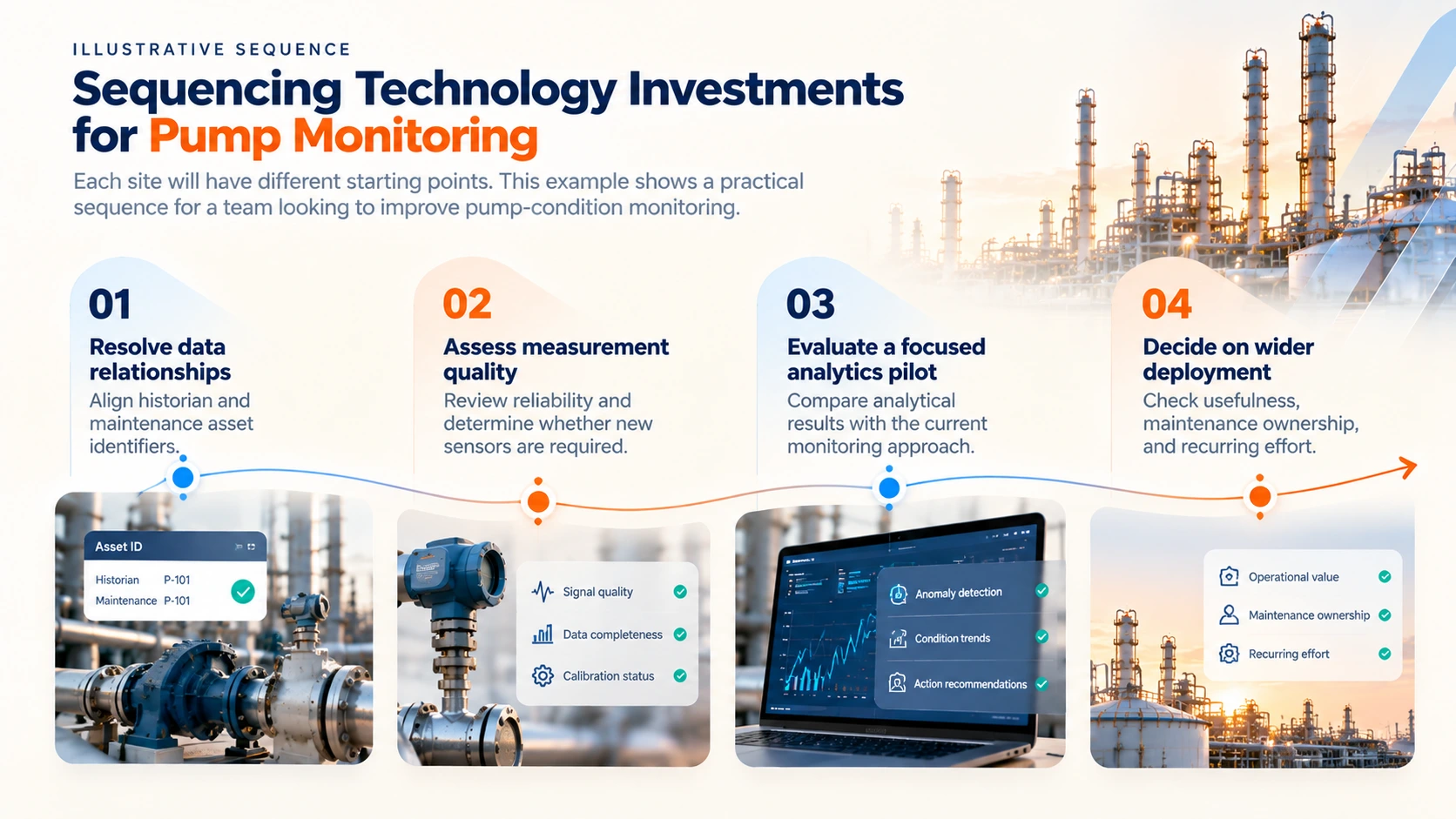
At another site, missing measurements may make instrumentation the first step. The application name is the same, but its technology dependencies produce a different implementation sequence.
Build a Roadmap the Operation Can Maintain
A downstream technology roadmap should show how each investment addresses an operating need and prepares the site for subsequent work. It should also make ownership and recurring costs visible, so the organization understands what it will take to maintain the capability after deployment.
Oil and gas technology trends provide options to consider; the sequence should follow the refinery’s requirements and readiness. Where information is missing, measurement may come first. Where information exists but remains difficult to use, integration or analytical improvements may deserve priority.
Through technology advisory and selection, Proclink evaluates technology options against operational requirements and integration needs, giving refinery teams a practical basis for deciding what to implement first and what to defer.