


AI in oil and gas can inform decisions about equipment condition, production forecasts, and process performance. In refineries, its value depends on whether the information arrives in time and is reliable enough for the decision being made.
An equipment alert must give engineers a useful reason to investigate. A quality estimate must be suitable for its intended use. A planning forecast must reflect the constraints the refinery actually faces.
This article examines practical applications of artificial intelligence in oil and gas, with a focus on refinery operations. It explains where predictive models and AI assistants can contribute, what teams need to validate, and how engineering judgment guides their use.
These applications form part of digital transformation in downstream oil and gas, connecting technology investment with improvements in everyday operating decisions.
AI Use Cases in Oil and Gas: Refinery Applications
Detecting an unusual pattern, forecasting a future condition, and recommending an operating adjustment are different tasks. Each requires a suitable model, relevant evidence, and a clear way to evaluate its output.
For refinery teams, the starting point is the operational question: what do we need to recognize earlier, estimate more reliably, or evaluate more effectively?
Detecting Changes That Deserve Investigation
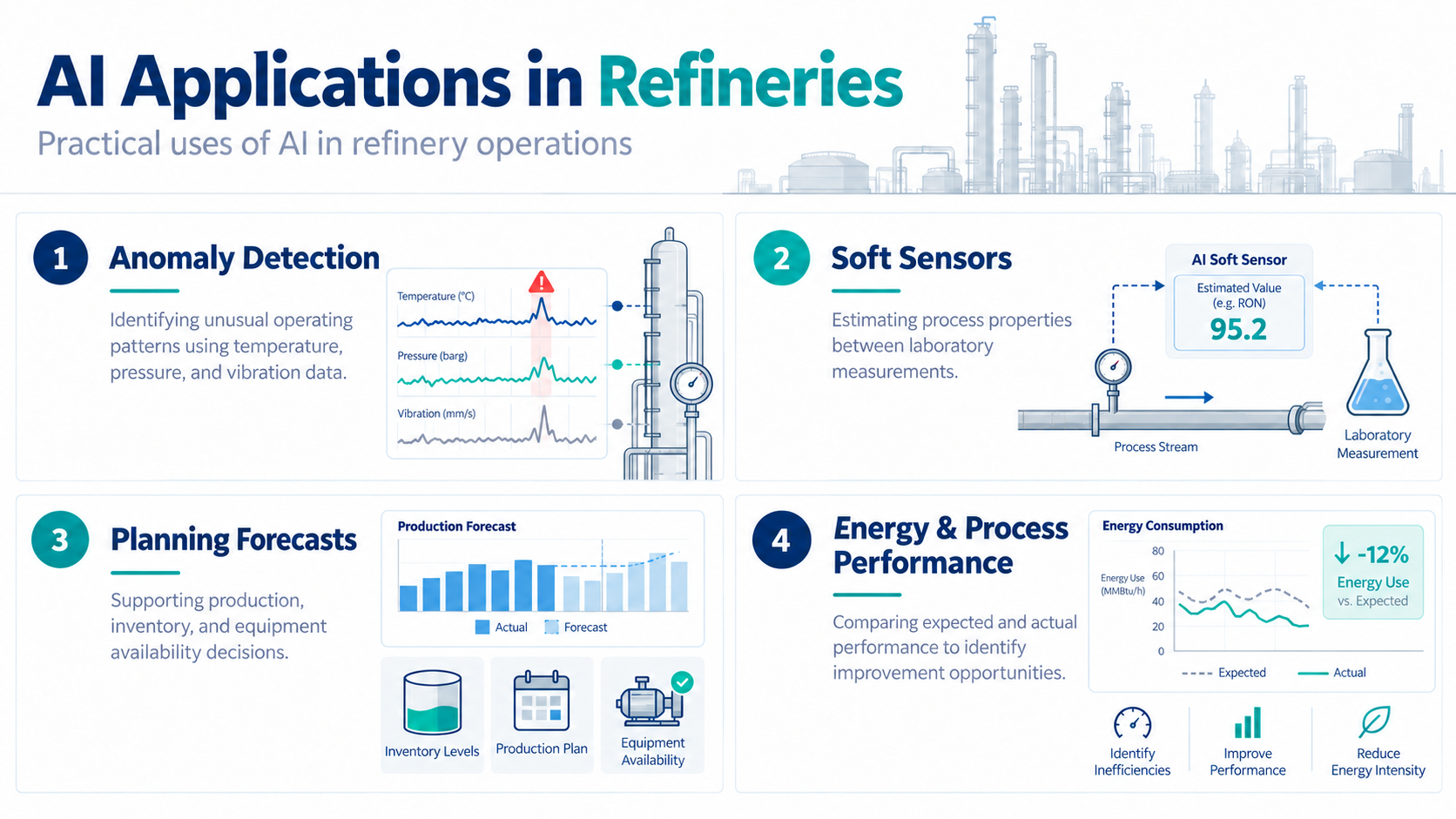
Anomaly detection models examine relationships across operating signals and flag behavior that differs from the patterns they have learned.
For example, a combination of temperature, pressure, and vibration changes may warrant attention even when individual readings remain within their usual limits. An effective alert identifies the signals involved and makes the model’s operating limits visible.
An anomaly is a reason to investigate. It does not, by itself, establish an equipment fault or identify its cause. A feed change, an operating transition, or an instrument problem may also explain the pattern.
For predictive maintenance applications, teams should evaluate whether alerts provide useful warning time and how often they trigger unnecessary investigations.
Estimating Properties Between Measurements
Some process properties are available only through periodic sampling or are difficult to measure directly. A soft sensor uses available measurements and a model to estimate a selected property.
For a refinery team, the practical question is whether the estimate provides useful information before the next measurement becomes available. Its suitability depends on the property being estimated, the operating conditions, and the accuracy required for the intended decision.
Users should be able to distinguish an estimate from a laboratory result. They also need to know when an estimate falls outside the model’s validated range. Introducing a model does not automatically remove the need for sampling or quality checks.
Improving Forecasts Used in Planning
Machine learning in the oil and gas industry can provide forecasts that inform production planning, utility requirements, inventory decisions, and equipment availability assessments.
For example, an updated estimate of unit capability could inform a planner’s assessment of production options. The resulting plan must still satisfy material balances, product specifications, equipment limits, and commercial commitments.
Forecast quality should be assessed over the period that matters to the decision. A model that performs well over a monthly horizon may not be suitable for daily scheduling.
AI can complement established planning and optimization methods. Planning software and dashboards are not necessarily AI applications, and adding machine learning does not remove the need to check whether a proposed plan is feasible.
Evaluating Energy and Process Performance
Models can estimate expected performance under particular feed, throughput, and operating conditions. Engineers can then examine differences between expected and observed results.
Where a model evaluates potential adjustments, its recommendations must respect operating constraints. An apparent energy benefit may involve a trade-off with product quality, throughput, equipment condition, or another unit’s performance.
A statistical relationship alone is insufficient evidence for changing an operating condition. Process knowledge is needed to assess whether the relationship is credible and whether the proposed action is appropriate.
What Must Be Ready Before a Model Is Used?
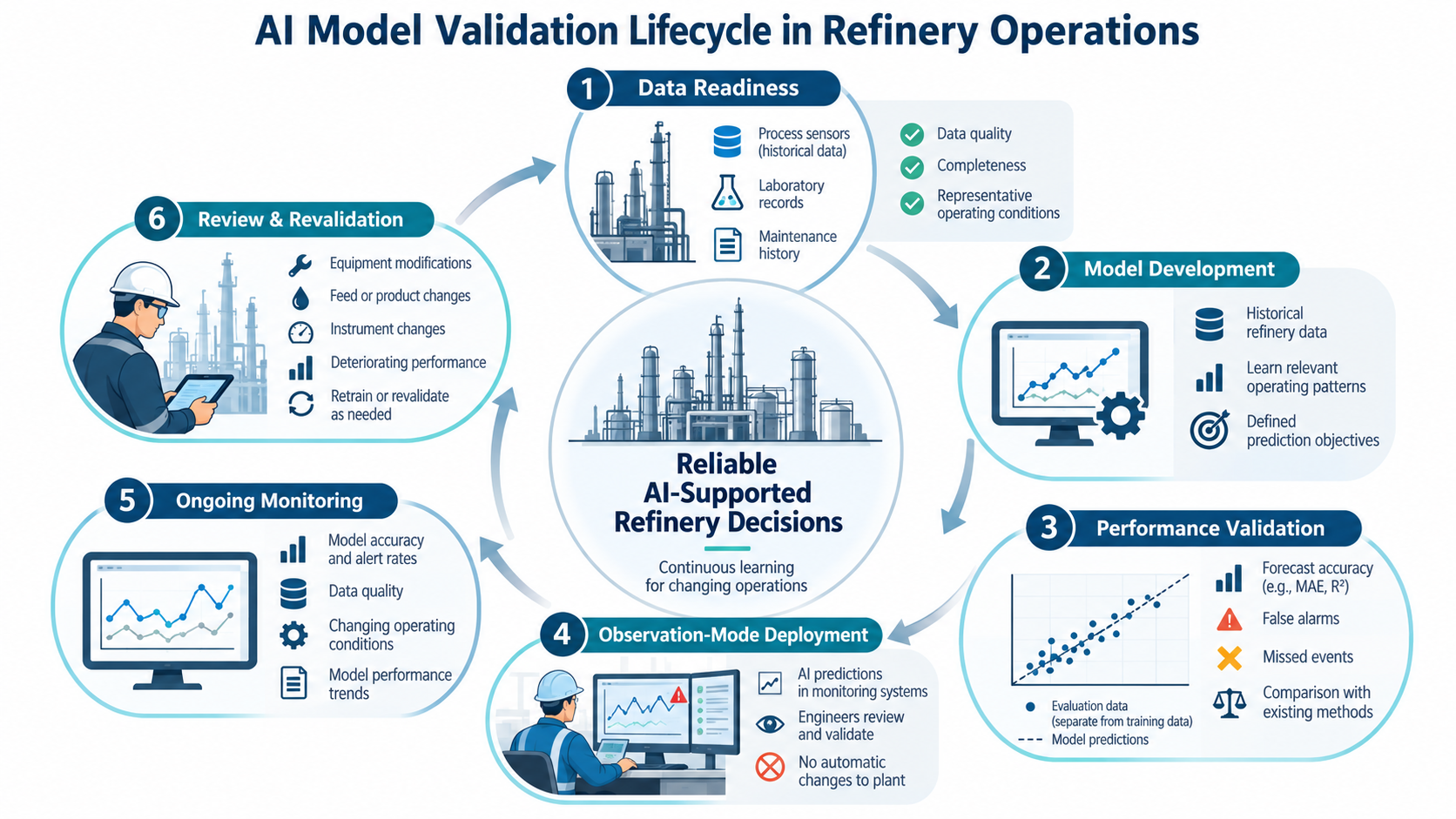
A refinery may hold years of historical information and still lack representative data for a particular AI application. Equipment failures may be rare, operating conditions may have changed, or maintenance records may not describe events consistently.
Reliable operational data foundations establish the connections between process historians, laboratory information, planning records, and maintenance history. AI introduces further questions about how those records are used to develop and evaluate a model.
Does the data cover the intended operating conditions?
A model trained on stable operation may behave poorly during startup. Changes in feed, equipment configuration, or operating mode may also affect its reliability.
Was the information available when the prediction would have been made?
A maintenance diagnosis recorded after an event must not be treated as information the model could have known beforehand. Otherwise, a historical test can make performance look better than it would be in daily use.
Does the model improve on the existing method?
Compare it with the current forecast, engineering calculation, or monitoring rule. Added complexity needs to produce a useful improvement.
Does the explanation make engineering sense?
Process knowledge can expose misleading relationships and identify missing influences. It also guides which recommendations are appropriate to test.
Who owns the response?
Establish clear responsibility for interpreting the output, assessing the supporting evidence, and documenting any subsequent action. An accurate prediction has limited value if no one can use it.
Where these checks reveal gaps, data engineering services can address source integration, data quality, and traceability as part of the implementation scope.
How to Validate AI in Refinery Operations
Model validation should reflect the decision the application will influence.
For an anomaly detector, examine false alarms, missed events, and warning time. For a forecast, assess error over the relevant planning horizon. For a soft sensor, compare estimates with suitable reference measurements across the conditions where it will be used.
Keep evaluation data separate from model development. For time-dependent applications, testing on later operating periods can provide a more realistic assessment than randomly mixing nearby records.
An initial deployment can run in observation mode, producing outputs without directing plant changes. Engineers can assess whether alerts are useful, whether recommendations arrive in time, and which conditions produce unreliable results.
The review should also define what happens when information is missing, a model becomes unavailable, or its inputs fall outside the validated range. Teams need a clear fallback and a way to suspend unsuitable outputs.
Validation continues after deployment. Equipment modifications, changing feed characteristics, and instrument changes can affect model performance. Ongoing monitoring should identify when investigation, adjustment, or revalidation is required.
A Refinery Example: Responding to a Compressor Alert
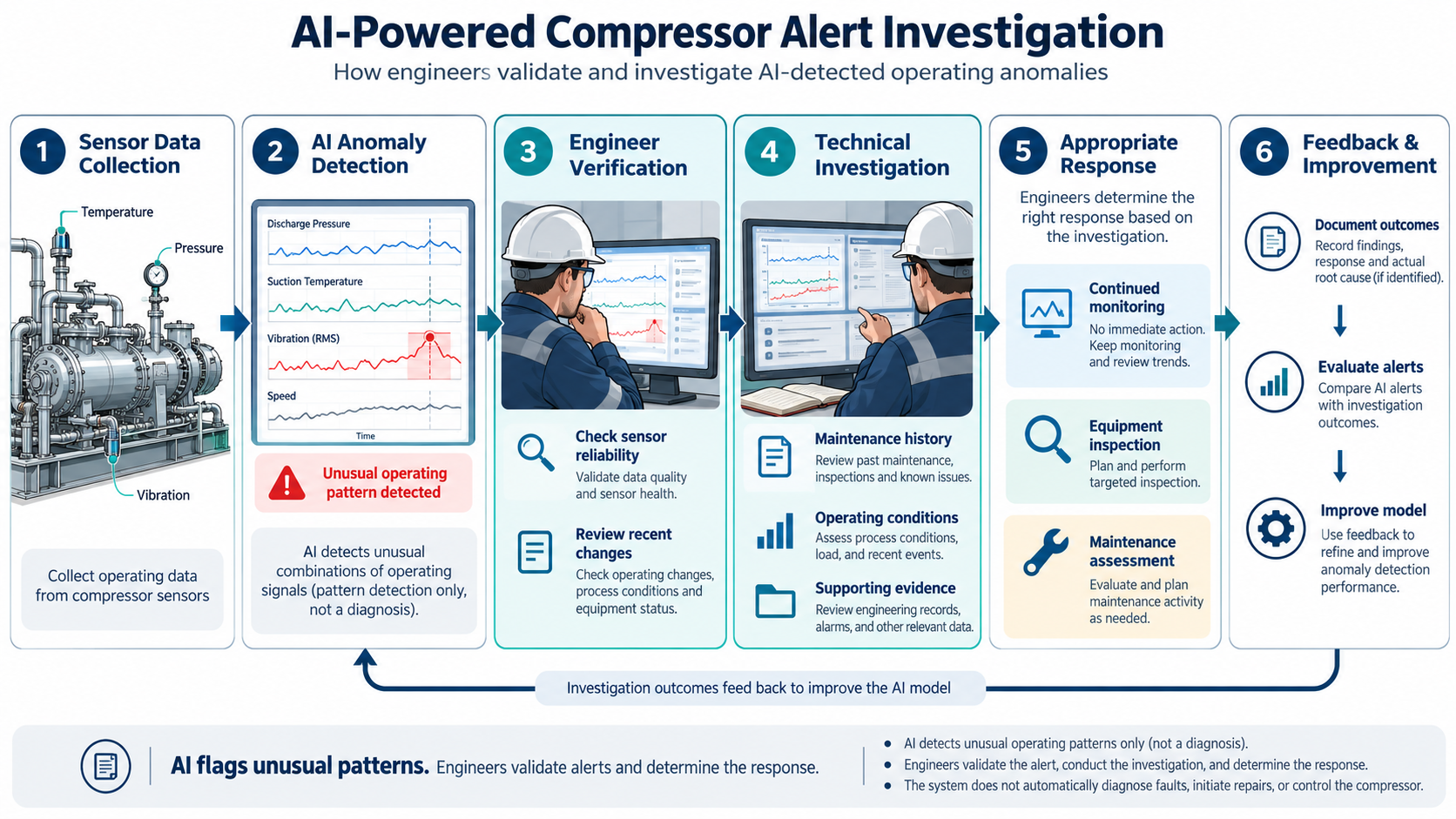
Consider an illustrative application monitoring a refinery compressor.
The model flags a combination of signals that differs from its learned pattern. The engineer first checks whether the instrument readings are credible and whether the compressor’s operating conditions have changed.
If the alert remains relevant, the team compares it with maintenance history and engineering evidence. The appropriate response might be further monitoring, an inspection, or a maintenance assessment. The model’s alert alone does not determine the action.
Recording the investigation outcome matters. The team should establish whether the observed behaviour resulted from an emerging equipment problem, a routine shift in operating conditions, or an unreliable signal. That feedback enables the team to evaluate the application’s usefulness and identify recurring weaknesses.
Success should be measured through useful warning time, investigation effort, and documented operating outcomes. The number of alerts generated is not a sufficient measure of value.
Where Generative and Agentic AI Fit
Predictive models evaluate numerical relationships. Generative AI offers a different capability: retrieving, summarizing, and organizing technical information.
A refinery assistant could retrieve approved procedures or assemble relevant investigation records with references to the source material. Access permissions, document versions, and traceable references matter because a fluent answer can still be incomplete or incorrect.
For a first workflow application, an agent could prepare an investigation record for review. Any authority to assign work, change a schedule, or influence operating settings should be explicitly defined and validated.
Human oversight must be practical. Those responsible for reviewing the output should have access to relevant information, sufficient time for evaluation, and the authority to question its findings. Their role should include assessing whether the recommendation is suitable for the current operating situation.
Choose the First Application Around an Operating Decision
A useful refinery AI project begins with a decision that someone already owns.
Choose a recurring problem, identify the evidence available, and agree how improvement will be measured. Then assess whether AI is suitable and how its output will enter the existing workflow.
For a maintenance application, the objective might be more useful warning before a specific equipment issue. For a planning application, it might be a more dependable forecast at the required decision horizon. Each needs its own baseline and acceptance criteria.
Proclink’s refinery analytics and AI capabilities provide a starting point for reviewing relevant applications. Through AI consulting and implementation, refinery teams can define the use case, assess data readiness, and establish a deployment approach with appropriate monitoring and ownership.
The aim is an application that teams can evaluate, use, and improve, with confidence in its purpose and a clear understanding of its limits.