

Overview
A downstream energy company needed a faster, more structured way to analyze deviations between planned and actual performance across business-critical KPIs. Performance data was distributed across multiple sources, while business users lacked a unified environment to monitor KPI deviations, investigate root causes, and manage follow-up actions.
Proclink developed an automated Plan vs. Actual analysis and root cause analysis solution that brought critical performance information into a unified environment. The solution enabled near real-time performance monitoring, root cause classification, intuitive reporting, and task management, helping business users identify deviations faster and take more informed corrective action.
The Client
The client is a downstream energy company specializing in petroleum refining, marketing, and transportation. Its infrastructure spans 10+ refineries interconnected through multiple transportation modes.
The Challenge
Business users needed a faster way to understand deviations between planned and actual performance across critical KPIs. Existing performance information lacked a unified dashboard, making it difficult to bring KPI monitoring, root cause analysis, task assignment, and follow-up into a connected process.
The requirement went beyond identifying a deviation. Teams needed to understand the parameters contributing to the issue, determine the root cause, and translate those insights into corrective action.
- Performance Deviation Analysis: Automate Plan vs. Actual analysis to enable faster decision-making.
- KPI Management: Provide structured visibility into business-critical KPIs.
- Root Cause Analysis: Identify the parameters contributing to KPI deviations.
- Task Management: Connect identified issues with task assignment and follow-up.
Objectives
The initiative was designed to:
- Automate analysis of deviations between planned and actual performance
- Perform root cause analysis for business-critical KPI deviations
- Surface key insights to improve adherence to plan
- Enable business users to perform KPI backcasting at month-end
- Bring KPI monitoring, analysis, and task management into a unified environment
Our Approach
Proclink designed a connected approach to automate Plan vs. Actual performance analysis and make deviations easier to investigate. Critical KPIs and their associated operating parameters were structured for analysis, while multiple data sources were integrated to provide near real-time performance visibility.
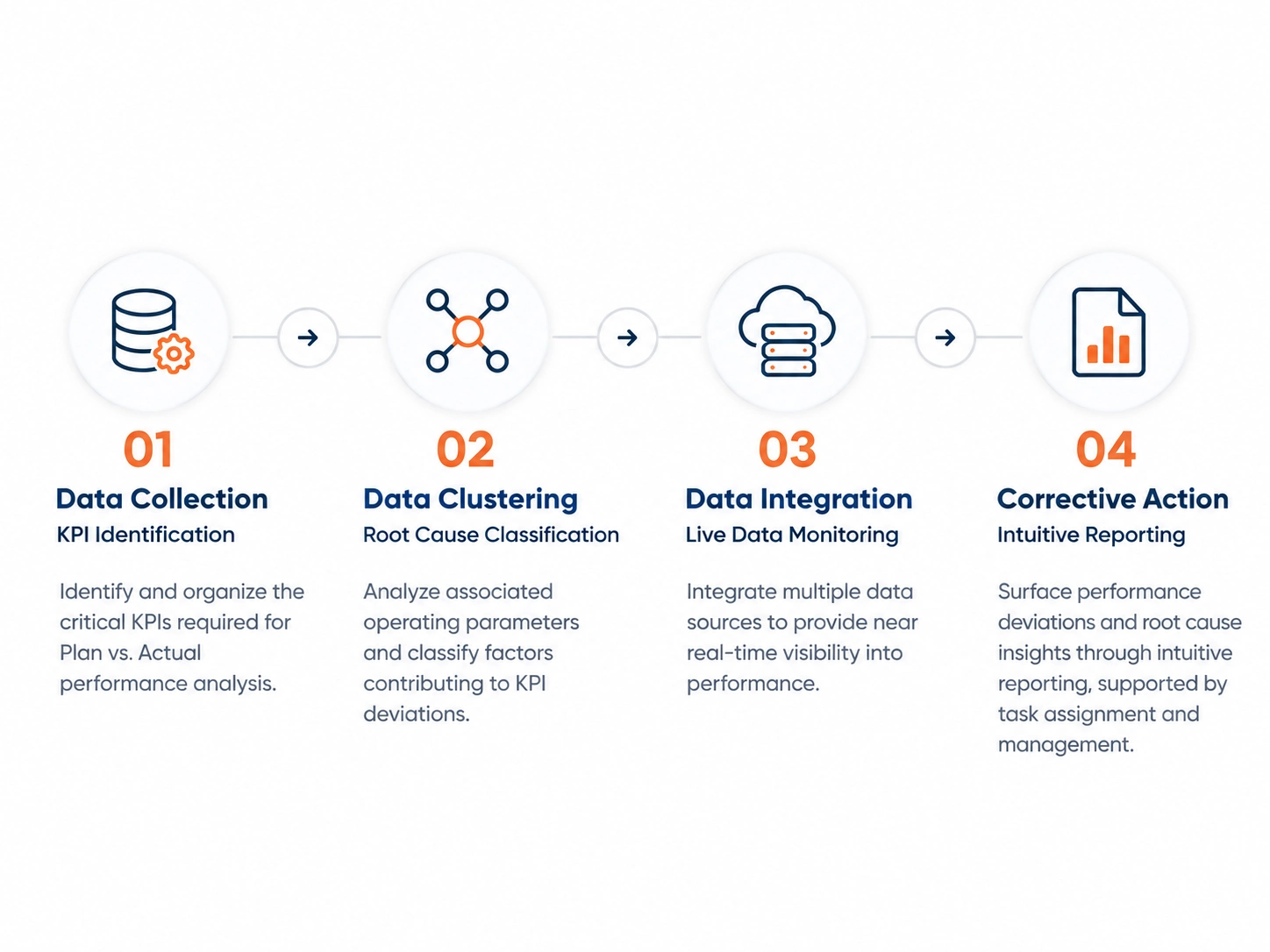
The approach connected KPI monitoring with root cause classification and action management. When performance deviated from defined thresholds, business users could investigate the associated operating parameters, identify likely root causes, review insights through intuitive dashboards, and assign follow-up actions within a more structured workflow.
What We Delivered
Proclink developed an integrated Plan vs. Actual analysis and root cause analysis environment supported by task management capabilities. The implementation began with an MVP and was subsequently scaled across the identified KPIs.
| Implementation Scope | Solution Capabilities |
|
49 Critical KPIs |
Plan vs Actual Analysis |
|
~ 900 Associated Operating Paramters |
Near Real-time Monitoring |
|
2 Refineries in scope |
Root Cause Analysis |
|
4+ Integrated Data Sources |
KPI Backcasting |
|
|
Dashboards & Reporting |
|
|
Task & Action Management |
Business Impact
By bringing Plan vs. Actual analysis, root cause identification, and task management into a connected environment, the solution enabled business users to identify performance issues more quickly and respond through a more structured process.
Improved Plan vs. Actual Adherence
Improved performance visibility supported closer adherence between planned and actual outcomes.
Quicker Decision-Making
Automated deviation analysis gave business users faster access to relevant performance insights.
Easier Root Cause Identification
Associated KOPs and deviation analysis made contributing factors easier to identify.
Structured Task Management
Identified issues could be connected with task assignment and follow-up actions.